
Let me begin with the word, because the word is the argument.
In standard music notation, an ossia (oh-SEE-ah; /ɔːˈsiːə/)—from the Italian o sia, meaning "or else," "alternatively," "otherwise"—is a passage written above the main staff, offering the performer a different reading of the same phrase. Not a simpler version. Not a better one. An alternative. A choice. A path that exists because the primary one is not the only one.
I did not name my instrument. The tradition did. It named itself.
I mention this because every time I walk into a crime scene with it strapped to my back, someone calls it a lute.
Detective Handler calls it a guitar. My former colleague Vasquez called it a mandolin — an assessment that is insulting to both of us, and to the mandolin. A session musician at one of the downtown jazz clubs once referred to it as a "medieval banjo," which is why I now conduct all my after-hours business at the Cinnamon Hedgehog, where the staff at least ask questions before arriving at their wrong conclusions.
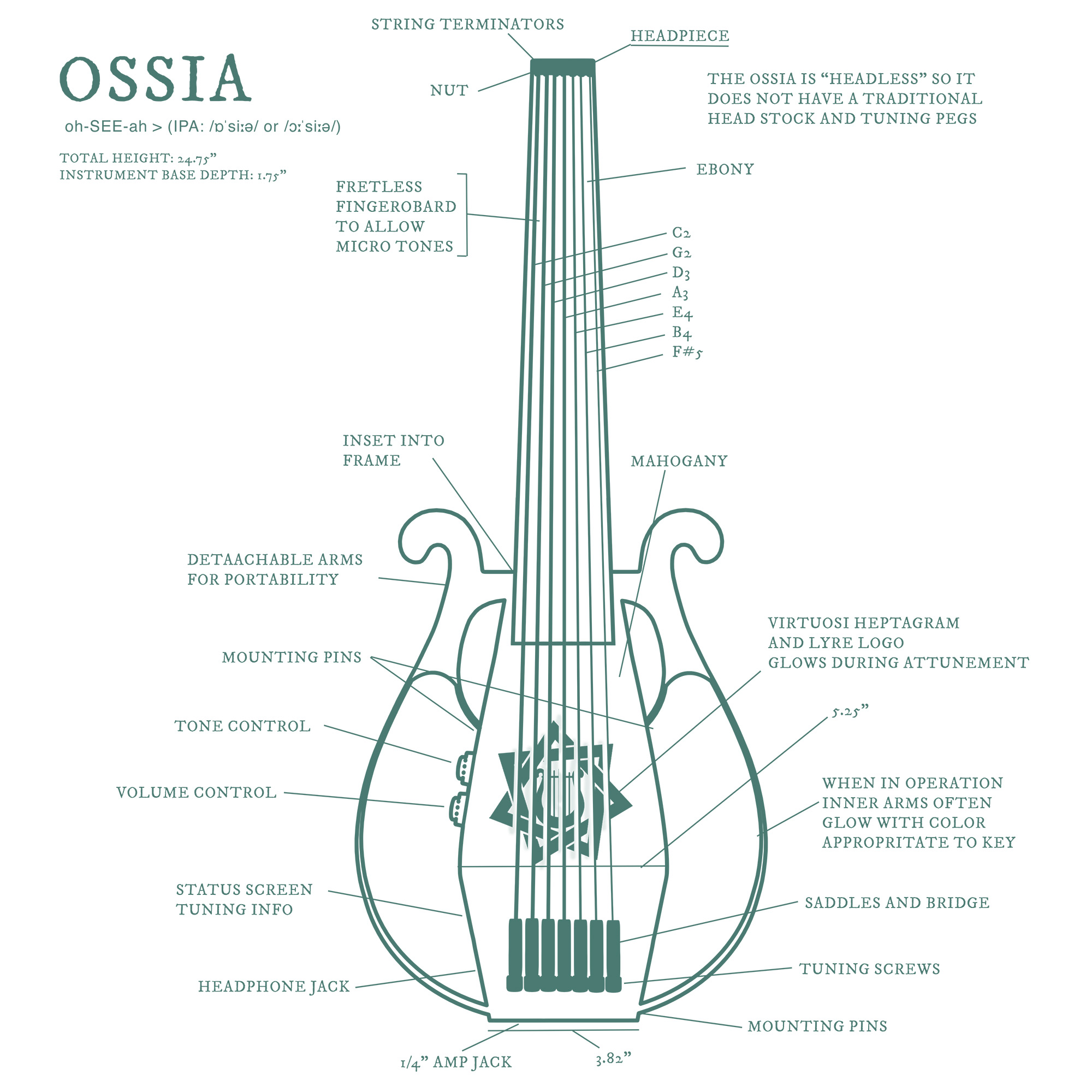
Architecture
The ossia is built around a central spine of African Mahogany. This material was chosen not for its acoustic resonance but for its structural density, since the instrument has no acoustic resonance to speak of. All electronics are housed within this spine, along with the headless bridge system. There is no headstock. There are no tuning pegs. Musical tuning is accomplished via precision screws at the base. This design choice eliminates the traditional head, drops the instrument's profile, and removes the first thing people point to when they are trying to decide which conventional category to force it into.
The dual "Lyre" arms—the curved frame that gives the ossia its distinctive silhouette—are modular. They detach via a pin-and-lock system, which allows the instrument to fit into a standard courier bag and which accounts for approximately seventy percent of the questions I receive from airport security personnel.
The fingerboard is grade-A ebony, 24.48 inches of smooth, fretless surface. There are no frets. I want to be precise about this, because the absence of frets is not an omission; it is the instrument's defining characteristic, the architectural decision from which everything else follows.
Without frets, the fingerboard does not tell you where a note is. It requires you to know.
This is harder. It demands a musculature of absolute precision, the kind of positional memory closer to cello technique than to any guitar. The nut is a single-piece block at 1.65 inches wide, accommodating seven strings in a spacing that offers very little margin for approximation. The practitioner's intonation must be exact, because the instrument will not correct you.
What it offers in return is access to the microtone—the notes that exist in the cracks between the twelve standardized pitches of the Western scale. The sliver of frequency between a C and a C-sharp. These are not wrong notes. They are notes that most instruments cannot reach, because their frets will not allow it.
The ossia is tuned to the Circle of Fifths: C₂, G₂, D₃, A₃, E₄, B₄, F#₅. This arrangement spans three and a half octaves, each string the natural harmonic successor of the one above it. This is not arbitrary. The perfect fifth is the most consonant interval in the harmonic series after the octave itself. When the strings are sounded, they resonate with each other in a way that twelve-tone fretted instruments approximate and the ossia simply is.
Silence
To those who ask why it has no soundhole: the ossia is a silent instrument.
This is not a flaw. In an ordinary room, an unplugged ossia produces a quiet, intimate sound—present but contained, unlikely to disturb your neighbors, unlikely to announce you to a room before you've decided to be announced. String tension translates directly into the output signal via a piezo-sensor array housed beneath the sigil plate on the body's face. The 1/4" jack at the base routes to an amplifier. The headphone jack allows for private operation. This arrangement also allows for further refinements during attunement, giving me an advantage over other less flexible instruments.
The volume knob governs amplitude. The tone knob shaves high-frequency overtones, narrowing the signal into a darker, more fundamental frequency. This is useful for certain kinds of work.
I am deliberately understating the implications of this. The Codex Harmonicus has other entries that address the applications of harmonic resonance in investigative practice. What I will say here is that an instrument designed to project into the room is a different instrument from one designed to listen through it.
The ossia listens.
What It Is
It is not a lute. A lute has a vaulted back, a peg box set at an angle, a soundhole, and a warm register in the upper-middle frequencies well-suited for renaissance parlors and the kinds of crimes that happen in them.
It is not a guitar. A guitar has frets, a fixed tuning in fourths, a body cavity intended to project sound into the air, and—crucially—a soundhole through which that projection occurs.
It is not an oud, a mandolin, a balalaika, a bouzouki, or a medieval banjo.
The ossia is an alternative. In the same way that the notation marking offers a different path through the same passage, this instrument offers a different mode of engagement with the harmonic world. It does not amplify sound into the room. It does not fill space with its presence. It translates. It listens past the ambient noise, past the emotional static of everyone present, to the residue underneath.
Every strong emotion leaves a harmonic signature. Every violent act leaves one louder. These signatures decay — hours, sometimes days — but while they persist, they are readable. If you know what you are listening for. If you have an instrument built to find them.
Trovatori have various theories about why. I have my own, which I intend to document more fully as my research continues.
What I will say is that the name is accurate. This instrument is the o sia, the "or else." The alternative path. It exists because the standard categories did not contain it, and because the work I do cannot be done with a lute.
—Filed with the Codex Harmonicus